The Aspirational Gap: How Premium Imagery Can Actually Kill Your Conversions
Beautiful photography can repel the very customers you're trying to reach. Here's why the aspirational gap exists — and how to know if your brand has one.
Every photographer knows bad images hurt sales. Almost nobody talks about what happens when the images are beautiful — and still wrong. This post is about the gap between who your customer thinks they are and who your imagery tells them they need to be.
Introduction: The Mug That Was Too Perfect
There's a camping mug I think about more than I probably should.
It was beautifully shot. Controlled studio lighting, clean white background, delicate shadows falling just where they should. Product sharp from handle to rim. Technically, whoever made those images knew exactly what they were doing.
And the product went nowhere.
Here's the thing: the images weren't bad. They were wrong. Campers looked at that pristine, carefully lit studio image and felt something they couldn't quite articulate — a subtle wrongness, a mismatch between what the product was promising and what they needed it to be. That thing looks too delicate to throw in a backpack and bang around a campsite.
The mug was actually rugged and camp-ready. The photography just never told anyone.
That's not a lighting failure. That's an aspirational gap — the distance between who your imagery tells the customer they need to be and who they actually are. And it's one of the most expensive, least discussed problems in product marketing.
Here's what makes it insidious: it doesn't always mean your images are bad. Sometimes it means they're too good. Too polished. Too perfect. Too far above the customer's sense of their own life.
And sometimes — as we'll see with one of the most studied brand collapses in retail history — it means someone traded a story for a status symbol, and paid for it with an entire customer base.
The Aspirational Gap: It Cuts Both Ways
Before we go further, let's be precise about what the aspirational gap actually is — because it operates in two directions, and both of them are dangerous.
Gap Type 1: Imagery positioned above the customer's self-identity. This is the camping mug problem. The product looks too refined, too precious, too expensive for the life the customer actually lives. The visual promise says "this is for someone with more taste, more money, more sophistication than you." The customer self-selects out — not because they can't afford it, but because the image made them feel like they don't belong in the frame.
Gap Type 2: Imagery positioned below the product's actual value. This is equally damaging and more common than most brands realize. I'm looking at a live example right now — a luxury olive oil priced at $60 a bottle, positioned in the market as a premium artisan product, competing with high-end European imports.
The imagery screams bargain shelf.
Single strip box lighting. That tell-tale one long reflection line running down the side of the bottle — the visual equivalent of "I had one light, I pointed it at the product, I took the picture." Plain white backgrounds with no gradient, no depth, no sense that this liquid inside deserves any more reverence than a $9 bottle from the grocery store middle aisle.
A customer willing to spend $60 on olive oil has already self-identified as someone with taste, standards, and a kitchen counter worth caring about. They're not buying oil. They're buying the experience of owning something exceptional. When the imagery doesn't confirm that self-image — when it contradicts it — the purchase hesitation is immediate and instinctive. Something feels off. The price says luxury. The image says otherwise. The customer doesn't trust the gap, and they move on.
In both cases, the product is fine. The market exists. The customer is reachable.
The photography just failed to close the distance.
The Neighbor and the Gatekeeper
When I'm behind the lens, I think about every image as a social signal. And the most important question I ask before a single light goes up is this:
Is this image supposed to feel like a neighbor, or a gatekeeper?
A neighbor invites you in. A gatekeeper makes you prove you belong.
Neither is wrong — but deploying the wrong one for the wrong brand, the wrong product, the wrong customer, is where the aspirational gap opens up. Here are the four visual levers that control which side of that line your imagery lands on.
1. Visual Isolation: Depth of Field as a Social Signal
This one is more powerful than most photographers acknowledge.
When you shoot with a deep depth of field — where the actual café or kitchen or campsite is visible and readable in the background — the product lives in the real world. It's approachable. It belongs somewhere a human being actually goes. The customer can place themselves in the scene because the scene looks like somewhere they've been.
The moment you obliterate that background with razor-thin focus, you've moved the product into a vacuum of perfection. It becomes a trophy, not a purchase. The context is gone. The product exists nowhere and everywhere simultaneously — which is exactly the right signal for a certain tier of luxury, and exactly the wrong signal for a brand trying to say "this is for your life, not just your aspirations."
Depth of field isn't a technical decision. It's a social one.
2. The Cost of Space: Negative Space as Luxury Language
There's a psychological principle I call the Cost of Space — and understanding it will change how you evaluate every product image you ever look at again.
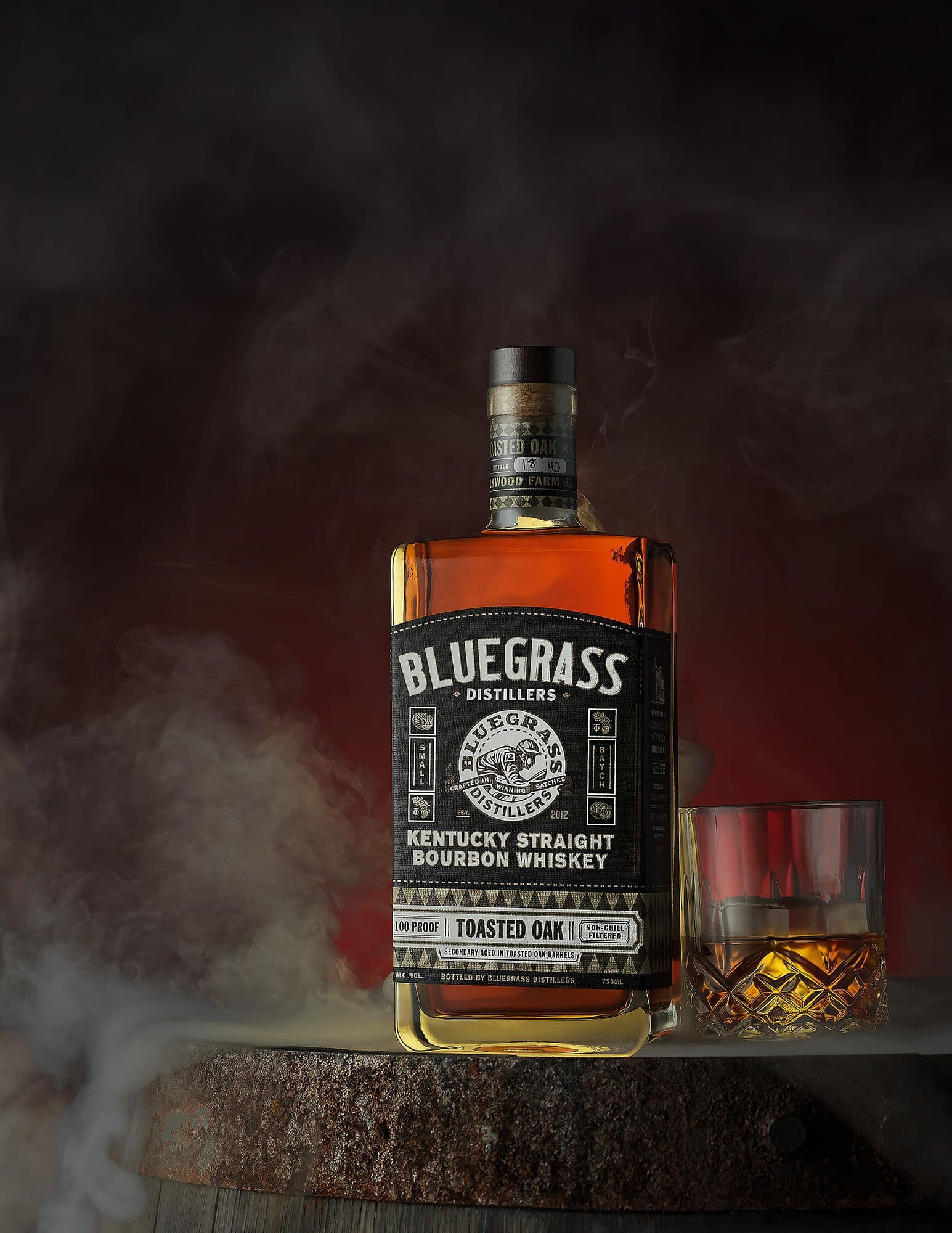
High-end luxury branding loves "wasted" space. If a bottle of bourbon occupies only 10% of a vast, minimalist frame, the brand is signaling something specific and deliberate: we are too prestigious to need to shout. The emptiness isn't emptiness — it's restraint. And restraint, in visual language, is expensive. It says we could fill this frame with anything we wanted, and we chose silence.
Compare that to the accessible shot — the frame filled with tactile human textures. Crumbs on a plate. Condensation beading on a glass. A slightly rumpled linen napkin. Those "imperfections" aren't accidents. They're invitations. They trigger a sensory response that says: I can touch that. I can afford that. That product lives in a world I recognize.
The luxury brand uses space to create distance. The approachable brand uses texture to close it. Neither is wrong. But using the wrong one sends the wrong message to the wrong customer — every single time.
3. Color as a Tier Signal
This one operates almost entirely below conscious awareness — which makes it more powerful, not less.
Retail-tier product photography tends toward high saturation and high energy. Colors pop. Contrast is punchy. The image is designed to grab attention on a shelf or in a social feed where it's competing with a hundred other images simultaneously.
Elite-tier imagery moves in the opposite direction. Muted, desaturated palettes. What I think of as "patina" colors — slightly aged, slightly restrained, the visual equivalent of a well-worn leather chair. The sophistication isn't in the brightness. It's in the subtlety. The image doesn't grab you. It waits for you to notice it.
For a brand living in the middle — the upscale local restaurant, the craft distillery, the artisan food producer — the color language has to be calibrated deliberately. Too saturated and you're signaling mass market. Too desaturated and you've priced yourself out of your own customer's comfort zone. The sweet spot is what I call High-End Relatability: professional lighting quality and color control that signals craft and intention, warm enough in tone that the customer feels invited rather than evaluated.
4. The Gaze: How Human Eyes Create Social Distance
If your imagery includes people interacting with your product, the way those people engage with the camera is doing more strategic work than almost any other element in the frame.
A model who looks directly into the camera and smiles is a peer. They're saying: I'm here with you. This product is part of our shared world. The social distance is zero. The customer feels seen and included.
A model who looks through the lens with zero expression — the classic editorial non-gaze, the "death stare" of high fashion — is doing something entirely different. They're not asking for the customer's approval. They're simply allowing the customer to watch. The social distance is enormous, and it's deliberate. This is aspirational imagery at its most extreme — and for certain luxury brands, it's exactly right.
For most brands? It's a gatekeeper where a neighbor would have made the sale.
The Banana Republic Autopsy: When a Brand Traded Its Soul for a Studio Strobe
If you want to understand the aspirational gap at its most catastrophic and most instructive scale, you need to understand what happened to Banana Republic.
Not what it became. What it was.
The original Banana Republic — before the Gap Inc. acquisition, before the repositioning — was genuinely singular. The catalogs were famous for hand-drawn illustrations in a rugged, adventure-traveler aesthetic. The "subject" of the imagery wasn't really a person at all. It was a journal entry. A field dispatch. Because the clothes were illustrated rather than photographed, they were semi-abstract — and that abstraction was the entire point. Customers could project themselves into the illustrations. They became the explorer on the Serengeti. They were trekking through the rainforest. The clothes weren't fashion — they were equipment for a life worth living.
Then someone made a decision.
The hand-drawn explorer became a high-gloss editorial model. The dusty, tactile, expedition-worn aesthetic became studio-strobed perfection. The clothes suddenly looked like they had never seen a speck of dirt — which, for a brand literally named Banana Republic Travel & Safari Clothing Company, was the ultimate visual lie.
The catastrophic image wasn't a single frame. It was a direction — and it didn't happen overnight. This was a slow sanitization. Gap Inc. didn't kill Banana Republic out of creative arrogance. They killed it out of efficiency. High-gloss studio photography scales across a large retail footprint. Hand-drawn expedition illustrations, rich with narrative and texture and soul, do not. Someone in a boardroom chose the production model over the identity. They chose scalability over soul — and the soul left quietly, one catalog at a time.
The moment an art director stopped asking "Does this sell a safari?" and started asking "Does this look like an award-winning fashion campaign?" — that was the moment the brand lost the thread.
They broke the self-projection. Customers were no longer the adventurer. They were now spectators staring into a world they hadn't been invited to enter unless they were among the beautiful people. The brand traded story for status. And for a customer base that had identified as rugged iconoclasts — people who bought Banana Republic precisely because it wasn't fashion — being told they were now "fashion consumers" felt like an insult.
In professional terms: the lighting became more important than the texture. The sheen of the studio strobe replaced the grain and dust of the expedition.
And here's the detail that reveals just how completely the visual strategy rewrote the brand's identity: they eventually dropped "Travel & Safari" from the name entirely. That sequence matters. The imagery led the name change — not the other way around. Once the studio strobes said "we are a fashion brand," keeping "Travel & Safari" in the name became untenable. The images had already made it a costume. So they removed it.
That's how powerful visual positioning actually is. It doesn't just reflect brand identity. It rewrites it. And the aspirational gap opened wide enough to swallow an entire loyal customer base — one perfectly lit, perfectly scaled, perfectly soulless image at a time.
Why This Keeps Happening: The Overfitting Problem
The Banana Republic collapse wasn't unique. The $60 olive oil with bargain shelf lighting isn't unique. The camping mug that communicated fragility to durability buyers isn't unique. This failure pattern repeats across brands, categories, and decades — and there's a systemic reason for it.
In data science, we have a term for this failure mode: overfitting. It's what happens when a model is tuned so precisely to a perfect, controlled dataset that it stops working in the messy real world. The model performs flawlessly in the lab. It fails the moment it encounters real conditions.
The creative approval process suffers from exactly this problem.
An art director and photographer stare at a flawlessly retouched 100-megapixel image on a perfectly calibrated monitor in a dark, controlled studio. Everything is correct. The color is accurate. The shadows fall perfectly. The composition is immaculate. They've optimized the image for their environment — and their environment has nothing in common with the environment where the customer will actually encounter it.
They aren't viewing it through the low-fidelity lens of a customer scrolling on a cracked phone screen while waiting for a bus. They aren't asking whether this image will sell a camping mug to a camper, or whether it's actually more directed at someone who will never set foot on a campsite. The sophistication that reads as quality in the studio translates as sterile and cold in the wild.
There's another layer to this failure: creative ego displacement. If high-gloss minimalist fashion imagery is winning Clio awards, photographers and art directors hired to shoot product campaigns will chase that aesthetic — not because it serves the brand, but because it serves their reputation. The question shifts from "What does this image need to say about the product?" to "What does this image say about me?"
That shift is where brands get lost.
They approved the file. Not the feeling.
Finding Your Brand's Visual Register: Tool, Treat, or Trophy?
Before we get to the practical diagnostic, I want to introduce a framework briefly here — one that deserves its own full treatment and will get it in an upcoming post in this series.
When I'm trying to determine where a brand sits on the neighbor-to-gatekeeper spectrum, I start by categorizing the product as a Tool, a Treat, or a Trophy.
A Tool is functional first. It solves a problem. The imagery should communicate competence, reliability, and ease of use. Visual clutter is fine — context is everything. This is a neighbor's product.
A Treat is an affordable luxury — something the customer indulges in because they deserve it, not because they've arrived somewhere. The $60 olive oil, done correctly, is a Treat. The craft beer from the local distillery is a Treat. The imagery should communicate quality and intentionality while keeping the door open. This is the High-End Relatability zone — professional lighting, warm textures, the ghost of a human presence.
A Trophy is a status object. It signals arrival. The customer isn't buying a product — they're buying what the product says about them. For Trophies, the luxury visual language is appropriate: vast negative space, muted palette, no human presence, immaculate isolation. This is the gatekeeper's territory — and it's the right territory, for the right product.
The mistake most brands make is shooting a Treat like a Trophy, or a Tool like a Treat. The aspirational gap opens every time the visual register doesn't match the product's actual role in the customer's life.
We'll go deep on the full diagnostic framework — including the Adjacent Ritual and the Human Proxy — in an upcoming post. For now, the question worth sitting with is simply this: Is your product a Tool, a Treat, or a Trophy — and do your images know which one it is?
A Practical Diagnostic: Is Your Imagery a Neighbor or a Gatekeeper?
You don't need a full creative audit to start answering this question. Here's a five-point diagnostic you can run against your current product imagery right now.
1. The Scroll Test. Pull up your product page on your phone — not your desktop, your phone. Scroll past your hero image at normal speed. What did you feel in the half-second before you stopped? Intrigue and warmth, or distance and exclusion? If the image made you feel like a visitor rather than a potential owner, your imagery may be operating as a gatekeeper when your customer needs a neighbor.
2. The Customer Mirror Test. Look at your imagery through the lens of your customer's self-identity, not just their demographics. Ask yourself: is the world inside these frames a place they can project themselves into, or is it a club they aren't invited to join? The best commercial imagery isn't a window into a distant world — it's a mirror that shows the customer a slightly better, yet entirely reachable, version of their own reality.
3. The Texture Test. Count the human imperfections in your imagery. Condensation. Crumbs. A hand. A shadow that belongs to someone just outside the frame. A surface that shows use. Zero imperfections signals Trophy territory. Warm, tactile detail signals Treat or Tool territory. The question isn't which is better — it's whether you're in the right zone for your product and your customer.
4. The Price Alignment Test. Show your imagery to someone who doesn't know your product or price point and ask: what would you expect to pay for this? If their answer runs significantly lower than your actual price, your imagery is underselling you. If it runs significantly higher, you may be triggering the aspirational gap — pricing the customer out emotionally before they ever see the number.
5. The "Would I?" Test. Simple and ruthless. Look at your imagery and ask: if I were my own target customer, would I feel like this product was made for me? Not for someone I admire. Not for someone I might become. For who I am, right now, on a Tuesday morning.
If the honest answer is no — that's exactly where the gap is.
The Bottom Line
The aspirational gap is one of the most expensive problems in product marketing precisely because it's invisible in the creative process. The images look beautiful. The studio approves them. They go live. And somewhere between the perfectly calibrated monitor and the cracked phone screen on the bus, the feeling gets lost.
Your customer isn't buying a product. They're buying a reflection of who they are — or who they want to be in a way that feels reachable. The moment your imagery stops reflecting that and starts reflecting the photographer's aesthetic, the art director's award aspirations, or a luxury tier the customer hasn't self-identified with — the sale is already lost.
The difference between imagery that converts and imagery that alienates isn't always quality.
Sometimes it's just knowing whether your customer wants a neighbor or a gatekeeper.
And making sure your images know which one to be.
They approved the file. Not the feeling.
Kevin Boller is the founder of Insight Image Studio, a commercial photography studio specializing in product and beverage imagery. With 20 years in data analytics and 10 years behind the camera, he works with brands that are ready to treat photography as a business asset — not a creative expense. Based in Southwest Florida, working worldwide.